
P.S. My personal thanks to Mike & Sophie for letting me use their music and voice.

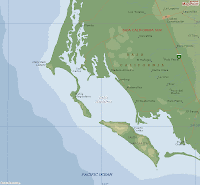 (about 300 miles north of Cabo) around 12:30pm on a late February Tuesday hoping to get "up close and personal" with the Pacific Gray Whales that breed in the bay and neighboring lagoons from January through March and are supposedly so abundant that you might trip over them. It was billed as a once-in-a-lifetime whale watching experience (2 to 2.5 hr trip for 1500 pesos for a party of 4 people).
 The mother and the calf then decided to just hang around and play with us. They turned and twisted around the boat, circled the boat, dove under the boat to surface on the other side. One time the mother went under the boat and the calf dove over her but still under the boat and came so close to the boat that I was able to touch the back of the calf - it was smooth like a baby's bottom, very soft like I was digging my hands through butter but the skin was very tight and shiny black with no barnacles... that was once-in-a-lifetime experience!!!
 got drenched in the spouts from the blowholes of the mother and the calf a few times. They must have swam and played with us for about 15 minutes when the skipper said we had to leave. As he started the engine and maneuvered the boat back towards the land the mother whale started following us. We stopped the boat 50 or so feet away and both the whales came over and continued with their horsing around. Some on the boat worried about capsizing but nothing of the sort happened. And then the whales were joined by sea lions who showed up just like that from nowhere. They jumped out into the air and dove ahead of and around the whales... It was a scene to behold - the joyous wildlife of Baja waters dancing around our boat. We were of course ecstatic. Absolutely Amazing!

 Just finished three days in Sharm El-Sheikh, an Egyptian resort city at the tip of Southern Sinai on the Red Sea famous for its diving. The whole area is, geographically speaking, basically mountain deserts coming right up to the ocean with deep indigo blue waters. I made 4 dives in the Ras Mohamed National Park here to discover massive underwater landscapes with sheer cliffs dropping off into the deep, caves you could move in and out off, and teeming with lush multi-colored corals and tons of schools of fish. The underwater visibility here was stunningly clear and stretched far. I saw a new fish – Crocodile Fish. Didn't see what people claim here is pretty common – sharks, mantaray, hammer heads, and few others.
 The town by itself (with its two parts, Old Sharm and Naama Bay, that are 10 minutes apart) has been turned into a European tourist destination with almost nothing Egyptian about it. Predominantly the tourists are from Russia, Italy and UK. The town is pretty deserted during the day when people are either diving or snorkeling or lallygagging on the beaches of major resorts runs by the likes of Hilton, Marriott, Sofitel, and some European outfits like Movenpick and Iberotel. The evening comes alive with tourists wandering the promenade trying all kinds of non-Egyptian food (Hard Rock cafe', TGI Fridays, Italian food places, etc.), smoking sheesha (hookah) at upscale versions of Cairo coffee shops and shopping for souvenirs.
 And then the whole place explodes after 11pm when the discotheques dance music. start pumping out loudAll three of major clubs - Pacha (best space - partly open air), Little Buddha (best music), and Hard Rock Cafe (so-so) were jumping till 4am. At night the whole place does not have a hint of Egypt, the Egypt I discovered everywhere else - traditional conservative muslim society. The only exception was that in all the clubs there was a noticeable feature - multitudes of Egyptian men hanging out at the periphery of the dance floor staring and feeling awkward. The younger ones are much more adventurous to hit the dance floor and mingle with the tourists but majority abstain from such outings. A crazy dynamic!
 The weird thing about the whole place is you see almost no Egyptian women. Since they do not work in any of the establishments (restaurants, souvenir shops, boats in the marina, etc.) its basically Egyptian men running everything. May be if Burqini's take off in Egypt the women here can enjoy the beaches and so many other water sports activities available to them.
 Because of recent history of terrorists attacks here the security is very tight and police sets up road blocks at the drop of a hat. I almost missed my flight out of town because of one such police check post where the police officer harassed my hotel minibus drives for good 15 minutes!
 I spent almost 5 days in the Western Desert in Egypt and discovered some amazing landscapes, proud people and interesting fellow travelers.

 Alexander the Great visited here to be declared son of Zeus by the famous Oracle in Siwa; a few centuries later Cleopatra visited as well and bathed in one of the natural springs (I swam there as well – the bubbles do tingle!); the British and the Italians bombed each other around Siwa during WWII...
 Yesterday, on a hazy morning, I took a 45 minute cab ride from Cairo city center to the Giza Plateau. Its only about 15 miles but the notorious Cairo traffic gets in the way.


